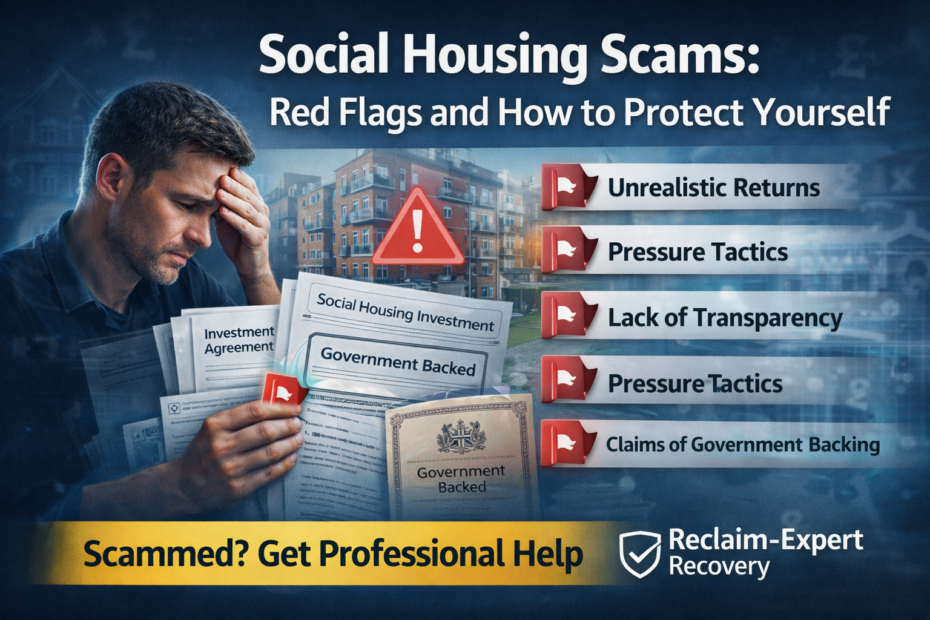
In recent years, there has been a significant increase in scams involving so-called “social housing” investments. These opportunities are often marketed as ethical ventures, promising attractive returns while contributing to affordable housing initiatives.
Unfortunately, many of these schemes later collapse and are found to be fraudulent, leaving investors with severe financial losses.
At Reclaim-Expert Recovery, we have supported victims affected by multiple failed social-housing-related investments. Through detailed case reviews, we have identified consistent warning signs that investors should recognise. While losses can be distressing, we have successfully assisted many clients in pursuing reimbursement where appropriate.
How Social Housing Scams Typically Operate
Fraudsters usually present themselves as property developers or investment companies with a social purpose. Investors are offered fixed returns — sometimes advertised at 20–30% annually.
In some cases, companies claim to be government-backed or partnered with social housing providers. These statements are frequently exaggerated or entirely false and are used to build credibility and trust.
Behind the scenes, funds are often misused — either not invested at all or used to pay earlier investors in a Ponzi-style structure. Eventually, the company reports financial difficulties or enters voluntary insolvency, and investor funds disappear.
Red Flags to Watch For
Unrealistic guaranteed returns
High, fixed profits with minimal risk are a strong indicator of potential fraud.
Secrecy or lack of transparency
Companies may refuse to name contracting partners, citing commercial sensitivity — often because no real contract exists.
Pressure tactics
Victims are urged to act quickly due to “limited opportunities” or deadlines designed to prevent proper checks.
Unregulated firms
Many schemes operate without authorisation from the Financial Conduct Authority (FCA).
Claims of ethical or social impact
While legitimate impact investing exists, scammers frequently exploit this narrative to gain trust.
Government-backed claims
Fraudsters often state funds are protected or supported by the government when they are not.
Vague explanations of fund usage
Investors are told money is used for property preparation or development but receive no verifiable breakdown.
Examples of Collapsed Schemes
Several schemes attracted substantial investor funding before failing, including projects claiming links to social housing providers, rent-to-rent models, or local authority partnerships — many of which were later proven false or misrepresented.
What To Do If You Have Invested
If you invested in a scheme you believe may not be legitimate, it is important to seek guidance promptly. Reclaim-Expert Recovery has extensive experience assisting individuals affected by investment fraud and may be able to help pursue recovery.
You are not alone — many victims only discover the truth after others come forward. Taking action early can significantly improve your options.
Who We Can Help
If your investment was made from a UK bank account, recovery options may be available. We manage claims from start to finish, reducing the stress of handling complex financial disputes. Our fee structure is transparent and clearly explained before proceeding.
It is also important to note that you are entitled to represent yourself at no cost if you prefer.
To date, we have assisted in recovering substantial sums for clients, including cases linked to social housing investment failures.
How the Process Works
We begin with a detailed review of your circumstances to understand what occurred. After initial documentation is completed, we manage the case on your behalf, communicating with your bank and, where necessary, the Financial Ombudsman Service.
Most cases take approximately 3–10 months, although timelines vary depending on complexity.